FLUIDANALYTICS.AI
Why Water Intelligence Is Becoming Essential for Sustainable Global Operations
May 26, 2026
LEUVEN, BE—From Water Infrastructure to Global Supply Chains: Fluid Analytics Joins the 100+ Accelerator Cohort 7
The future of water sustainability will not be built by utilities alone.
As global populations grow, climate pressures intensify, and water resources become increasingly constrained, businesses across every sector are being challenged to rethink how water is monitored, managed, and protected throughout their operations and supply chains.
This challenge extends far beyond regulatory compliance. Water availability, wastewater management, environmental stewardship, and operational resilience are becoming strategic priorities for companies seeking to build more sustainable and future-ready businesses.
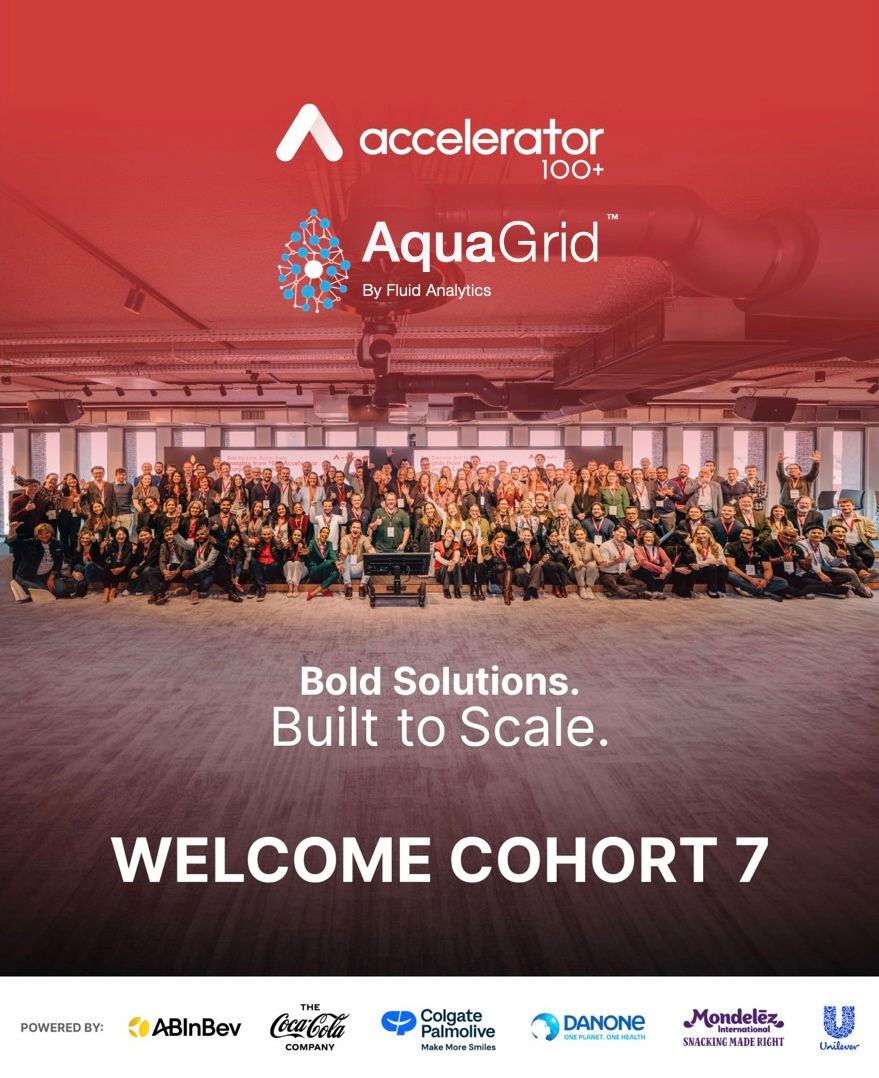
Recognizing the importance of accelerating solutions to these challenges, the 100+ Accelerator has announced its seventh cohort of startups working alongside some of the world’s largest consumer goods companies to pilot and scale innovative sustainability technologies.
Fluid Analytics is proud to be among the 45 startups selected for Cohort 7.
Accelerating Sustainability Through Collaboration
The 100+ Accelerator was created to help emerging technologies move beyond proof-of-concept and into real-world deployment.
Supported by a coalition of global industry leaders including AB InBev, The Coca-Cola Company, Colgate-Palmolive, Danone, Mondelēz International, and Unilever, the program focuses on identifying solutions capable of delivering measurable environmental and operational impact across global supply chains.
The selected startups represent a diverse range of innovations spanning water stewardship, circular economy solutions, sustainable agriculture, climate resilience, packaging, energy efficiency, and digital transformation.
Collectively, they share a common objective: helping industries operate more sustainably while strengthening long-term resilience.
Why Water Intelligence Matters
Water remains one of the most critical - and often least visible - resources within industrial operations.
From manufacturing facilities and wastewater systems to watersheds and receiving environments, organizations face growing pressure to improve visibility into how water moves through their operations and impacts surrounding ecosystems.
At the same time, regulatory requirements, stakeholder expectations, and climate-related risks are increasing the need for proactive environmental management.
Yet many organizations continue to rely on fragmented datasets, periodic monitoring, and disconnected systems that make it difficult to identify emerging risks or opportunities for improvement.
This is where digital intelligence platforms are beginning to transform the industry.
Building the Intelligence Layer for Water Systems
Fluid Analytics is developing AquaGrid, an integrated intelligence platform designed to help organizations better understand and manage water systems across infrastructure, operations, and the environment.
By connecting data from inspections, environmental monitoring programs, sensors, weather systems, operational records, and water quality measurements, AquaGrid creates a continuous view of system performance and risk.
The platform helps organizations move beyond reactive monitoring toward predictive decision-making, enabling earlier identification of infrastructure issues, environmental risks, and operational inefficiencies.
For industrial operators, this means greater visibility into water-related risks, improved resource management, and stronger support for sustainability objectives.
For communities and ecosystems, it means better protection of waterways, reduced pollution risks, and more informed environmental stewardship.
A Global Perspective
Fluid Analytics’ technology has already been deployed across more than eight countries, supporting infrastructure systems responsible for monitoring and managing billions of liters of daily wastewater flow.
These deployments span diverse operating environments, including municipal infrastructure, industrial systems, environmental monitoring programs, and watershed-scale applications.
The resulting experience has reinforced a simple but powerful insight:
The future of water management depends on connecting infrastructure intelligence with environmental intelligence.
Organizations that can understand both will be better positioned to navigate growing sustainability challenges while building resilient operations for the decades ahead.
Looking Ahead
Participation in the 100+ Accelerator provides an opportunity to collaborate directly with global industry leaders committed to advancing sustainability across their operations and supply chains.
Through the program, Fluid Analytics will continue expanding the capabilities of AquaGrid while exploring new applications for water intelligence in industrial and environmental settings.
As industries increasingly recognize water as both a critical resource and a strategic risk, the need for actionable intelligence will only continue to grow.
The innovators selected for Cohort 7 are helping define what that future looks like.
Fluid Analytics is honored to contribute to that mission and looks forward to working alongside fellow cohort companies, corporate partners, and sustainability leaders to accelerate meaningful impact.