FLUIDANALYTICS.AI
Blueprints for Smart Water Systems
Dec 9, 2025
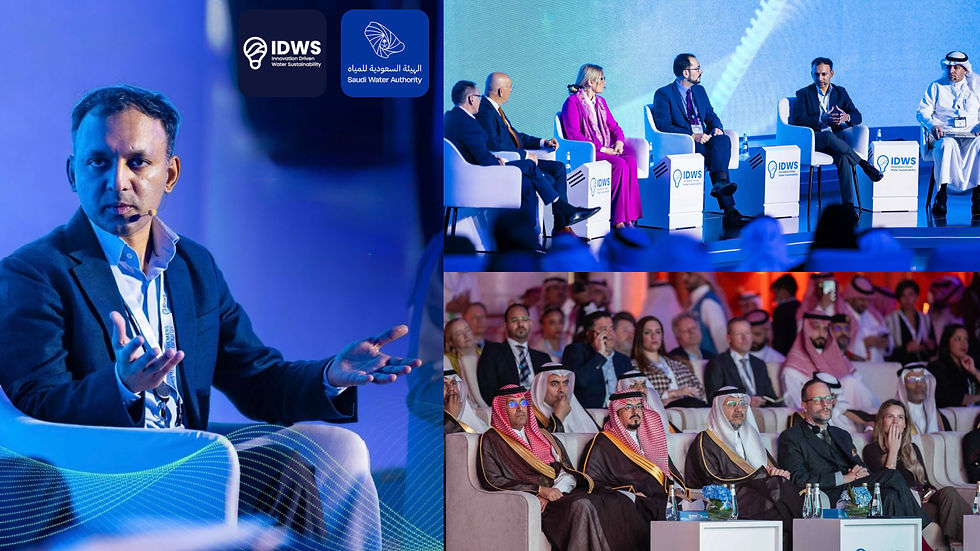
JEDDAH, SA—IDWS discussions highlight how integrated intelligence platforms are shaping the future of resilient urban water infrastructure.
At the International Desalination & Water Summit (IDWS), global water leaders, utilities, technology providers, and policymakers convened to define practical blueprints for smarter, more resilient water systems amid increasing climate variability, urban growth, and public-health risk. The session Blueprints for Smart Water Systems emphasized the need to move beyond fragmented digital tools toward integrated, catchment-scale intelligence.
A central theme of the discussion was the unification of traditionally siloed domains—wastewater and stormwater networks, drinking-water infrastructure, surface waters, and public-health monitoring—into a single operational framework. Participants highlighted how platforms such as Fluid Analytics are demonstrating this shift in practice by combining AI-driven analytics, robotic inspections, IoT sensing, and wastewater-based epidemiology to deliver early warning and decision support across entire catchments.
Speakers underscored the transition from periodic inspection to continuous surveillance, enabled by advances in sewer robotics, real-time sensors, and genomic wastewater monitoring. These capabilities allow underground and surface-water systems to function as live observatories—detecting infrastructure failures, pollution events, flooding risks, and emerging health threats earlier and with greater confidence. Interoperable data architectures and digital twins were cited as essential for fusing infrastructure condition data with environmental signals such as rainfall, tides, and water-quality dynamics.
The session concluded with a call for cities to adopt system-level blueprints rather than isolated point solutions. By deploying integrated platforms that scale across entire catchments and align operational, environmental, and public-health objectives, utilities can improve resilience, regulatory compliance, and response effectiveness. The conversations at IDWS reinforced a growing global consensus: the future of smart water systems lies in integrated intelligence—an approach already being operationalized by innovators like Fluid Analytics in cities worldwide.